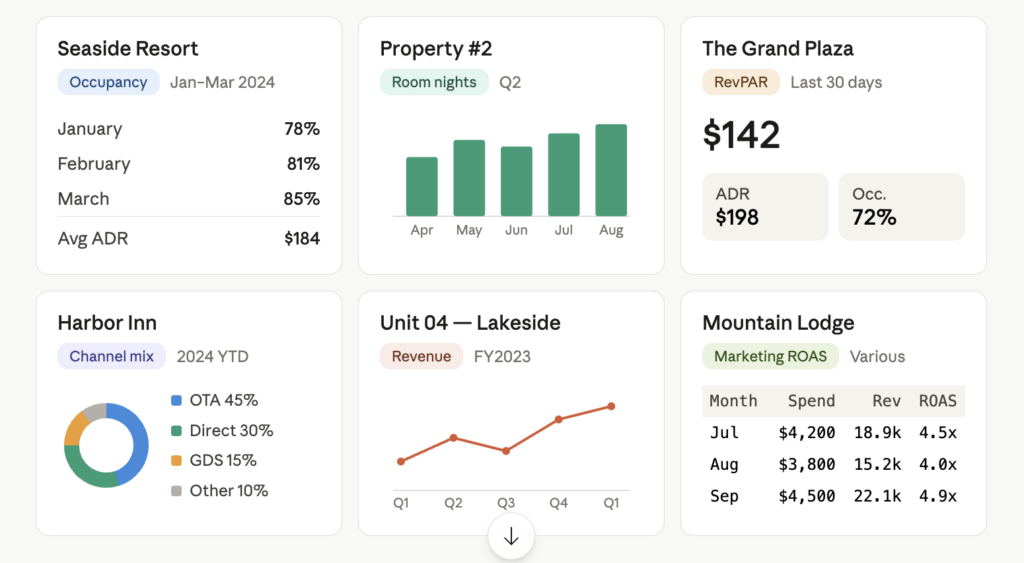
Hotel ownership groups and asset managers are awash in data. Every property produces reports on occupancy, bookings, marketing, and revenue. But because each property tracks and reports differently, it’s nearly impossible to compare results in a clean, consistent way.
The reality is that most reporting still happens at the property level. While useful, this creates blind spots when owners need to see the big picture.
Why portfolio benchmarking matters
Portfolio-level benchmarking changes the conversation from individual performance to collective insight. With a unified rollup, owners can:
Spot outliers — Identify top performers and struggling properties instantly.
Compare consistently — Measure ADR, RevPAR, ROAS, and direct booking share apples-to-apples.
Reallocate resources — Direct capital, staffing, or marketing investment where it will drive the greatest impact.
Build accountability — Ensure each property is held to consistent benchmarks, not arbitrary local standards.
A practical example
Imagine a 10-property portfolio. Eight hotels are delivering a healthy marketing ROAS, but two are significantly underperforming. With rollup benchmarking, those underperformers don’t get hidden in averages — they’re flagged for immediate attention. Owners can investigate if it’s a budget issue, a market dynamic, or an operational gap.
Meanwhile, standout properties become models of best practice. If one property is generating exceptional direct bookings, owners can replicate that approach across the portfolio.
From reactive to proactive leadership
With portfolio-level data, ownership groups move from reactive reporting to proactive strategy. Decisions about where to invest, where to intervene, and how to grow are backed by transparency.
For hotel groups, the future is clear: portfolio-level benchmarking is no longer optional. It’s the foundation of profitable growth.
Stop guessing. Start knowing.
Managing performance across multiple properties and channels shouldn't require hours of manual reporting or a tolerance for blind spots. GCommerce Rollup APIs give hotel operators and technology partners a single, unified view of their data: clean, structured, and ready to act on.
The Multi-Property Rollup API aggregates performance across your entire portfolio, so you can compare results by region, brand, or management group, all in one place. The Channel Rollup API brings paid search, metasearch, display, and social into a single schema, making it easy to evaluate true ROI and spot budget shifts across every media type.
Both APIs connect directly to the BI tools and dashboards you already use, backed by real-time endpoints, normalized data models, and two decades of hospitality data expertise. Integrate once. Scale everywhere.
Contact us todayto get started with your portfolio-level benchmarking.
Frequently asked questions about portfolio-level benchmarking
What is portfolio-level benchmarking for hotels?
Portfolio-level benchmarking is the practice of rolling up performance data from every property in a hotel group into a single, standardized view. Instead of reading each hotel’s report in isolation, owners and asset managers can compare metrics like ADR, RevPAR, ROAS, and direct booking share on a consistent, apples-to-apples basis. This turns a stack of disconnected property reports into one clear picture of how the whole portfolio is performing.
Why isn't property-level reporting enough on its own?
Property-level reporting is useful for day-to-day management, but it creates blind spots at the ownership level because each hotel tends to track and format its data differently. One property might report occupancy in a table while another leads with RevPAR or only tracks channel mix, often across different date ranges. That inconsistency makes true comparison nearly impossible and lets underperformers hide inside portfolio averages until the problem is already costing money.
Which metrics should hotel groups benchmark across their portfolio?
Dark mode is no longer a niche preference. It’s a default experience for a growing share of users, especially on mobile. 📲 In fact, around 40% of email opens now happen in dark mode.
But here’s the challenge:
Your email doesn’t render the same across inboxes
Some platforms partially invert colors
Others completely transform your design
The result? Broken experiences at the exact moment your audience is ready to engage. 💔
Learn how to design emails for dark mode. Avoid common pitfalls, improve readability, and boost engagement in our full EBook. 👈
AEO vs GEO for hotels and resorts: What’s the difference?
AI is reshaping how travelers discover hotels and resorts. Traditional search rankings still matter, but AI-powered answer engines and generative platforms are changing how visibility works.
For hospitality marketing leaders focused on increasing direct bookings, understanding the difference between AEO and GEO is no longer optional. It is foundational.
This guide explains how answer engine optimization and generative engine optimization differ, how they connect to hotel metasearch and Google hotel ads, and how hotels and resorts can apply both strategies without overcomplicating their tech stack.
What is AEO for hotels and resorts?
Answer engine optimization, or AEO, is the practice of structuring content so AI-powered answer engines can quickly interpret and surface it in direct responses.
When a traveler asks, “Which hotels in Denver have rooftop pools?” an AI tool scans structured, trusted sources to provide a concise answer. AEO ensures your property’s content is clear, factual, and formatted in a way that increases the likelihood of being referenced.
For hotels and resorts, AEO focuses on:
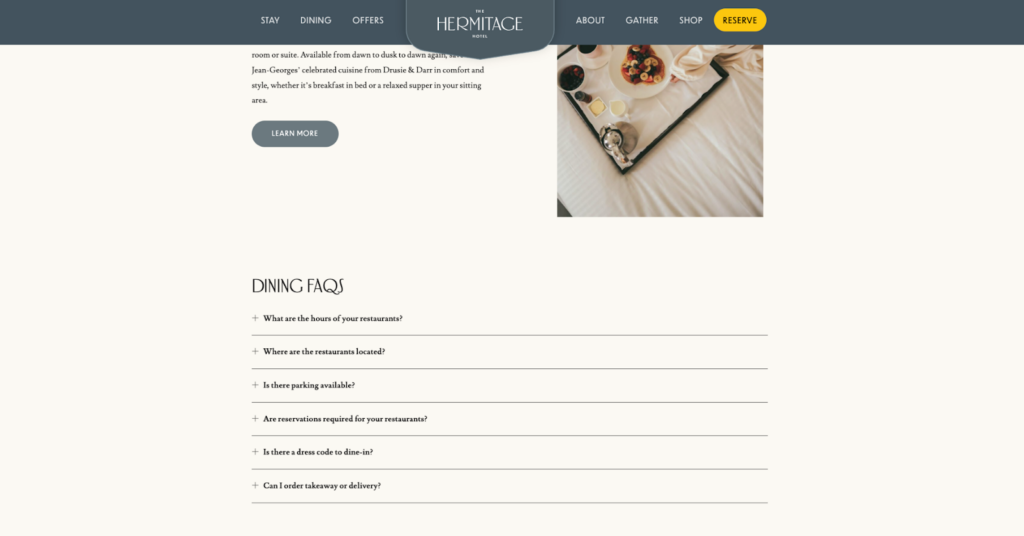
Clear FAQ sections
Structured property details and amenities
Consistent descriptions across platforms
Accurate location and policy information
AEO supports hospitality marketing by improving visibility in conversational and voice-based search experiences before the traveler ever clicks a traditional result.
What is GEO for hotels and resorts?
Generative engine optimization, or GEO, focuses on how AI models synthesize and regenerate information about your property.
Instead of pulling a short answer, generative engines create narrative responses such as:
“Top boutique hotels in Austin for couples include properties known for walkable locations, spa amenities, and curated dining experiences.”
GEO ensures your property’s value proposition, positioning, and differentiators are clearly written so generative AI tools can accurately represent them.
For hotels and resorts, GEO emphasizes:
Clear positioning statements
Context-rich descriptions
Defined audience segments
Structured storytelling grounded in factual data
GEO extends traditional SEO into AI-generated environments where content is summarized, blended, and rephrased.
AEO vs GEO: What is the core difference?
The difference comes down to retrieval vs regeneration
AEO helps AI retrieve and display factual answers
GEO helps AI generate accurate, narrative summaries
AEO supports discoverability in direct answer formats. GEO shapes how your property is described in broader AI-generated recommendations.
Both influence awareness. Both shape perception. And both ultimately support direct bookings and AI search visibility when executed strategically.
Why AEO and GEO matter for direct bookings
Direct bookings depend on visibility, trust, and clarity. AI-driven discovery now plays a role in all three.
When your property appears in AI-generated answers:
Travelers gain confidence before comparing rates
Branded search demand increases
Hotel metasearch performance strengthens
Google hotel ads benefit from improved engagement signals
AEO and GEO do not replace hotel metasearch or paid search. They influence the demand that later converts through those channels.
For hotels and resorts working with a hospitality marketing agency or digital marketing agency, integrating AI visibility strategies into broader hospitality marketing plans ensures alignment between discovery and conversion.
How AEO connects to hotel metasearch and Google hotel ads
AEO operates at the top of the funnel. Hotel metasearch and Google hotel ads operate closer to conversion.
When AI tools confidently surface your property:
Branded search demand increases
Travelers search by property name
Hotel metasearch listings receive higher intent traffic
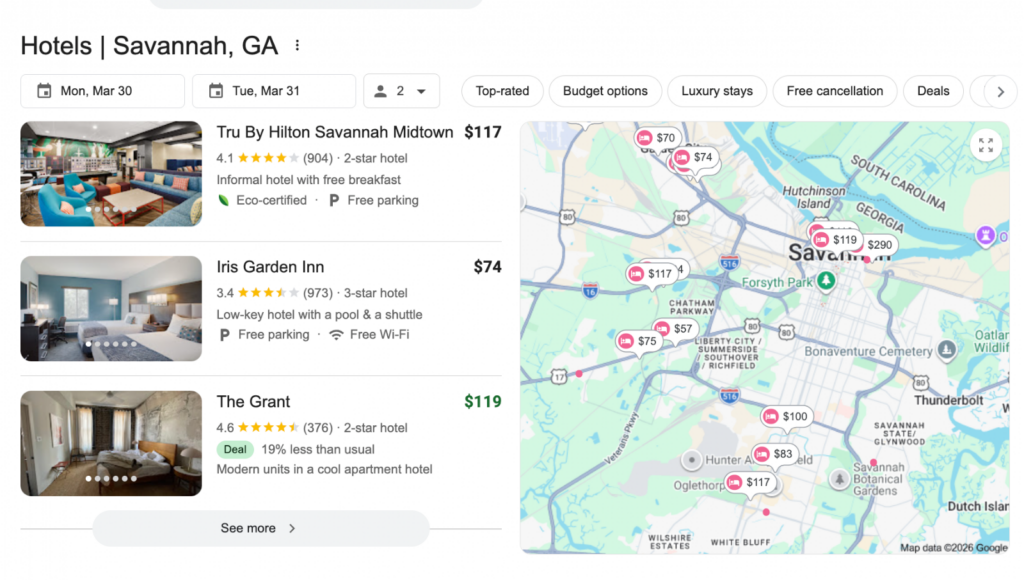
Google hotel ads capture conversion-ready users
The impact is indirect but measurable. Improved branded demand and engagement signals strengthen overall channel efficiency.
This is where data becomes critical. Centralized performance data enables hotels and resorts to connect AI-driven visibility with downstream revenue outcomes.
How GEO strengthens hospitality marketing strategy
GEO ensures that when AI tools summarize travel options, your property’s positioning remains accurate.
Without GEO:
AI may default to third-party descriptions
Outdated OTA copy may shape perception
Differentiators may be diluted
With GEO:
Your value proposition remains intact
Amenities and experiences are clearly represented
Audience targeting aligns with traveler intent
For a marketing agency for hotels and resorts, GEO becomes an extension of brand governance in AI environments.
Do hotels need separate teams for AEO and GEO?
No. AEO and GEO share the same foundation:
Structured, centralized property data
Clear, concise website content
Performance accountability tied to revenue
Consistency across digital marketing channels
Hotels and resorts do not need separate initiatives. They need an integrated hospitality marketing strategy supported by a reliable data infrastructure. Across the industry, many use the two acronyms (AEO and GEO) interchangeably, because there is a lot of overlap in approaches and essentially they are similar strategies.
As highlighted in our brand and data platform strategy, intelligence only creates value when connected to activation.
How to get started with AEO and GEO without overhauling your property website
Hotels can take practical steps immediately:
Expand FAQ sections with concise answers
Clarify property descriptions to reduce ambiguity
Standardize amenity and policy language
Align website messaging with paid search and hotel metasearch campaigns
Connect booking data with marketing performance reporting
These updates improve AI visibility while reinforcing conversion performance across hotel metasearch and Google hotel ads.
No full redesign required. Just clarity, structure, and consistency.
Final perspective: AEO and GEO are not trends. They are visibility layers.
For hotels and resorts focused on increasing direct bookings, AEO and GEO represent new layers of digital marketing strategy.
They shape discovery before the click. They influence perception before comparison. They strengthen the channels that convert demand into revenue.
When grounded in structured data, integrated reporting, and performance accountability, AEO and GEO become strategic advantages, not marketing experiments. And for hospitality leaders, that clarity makes all the difference.
Frequently asked questions about AEO
How can hotels measure the impact of AEO and GEO on digital marketing performance?
Hotels can measure the impact of AEO and GEO by tracking increases in branded search demand, engagement rates, and conversions across hotel metasearch and Google hotel ads. When AI-driven visibility improves, properties often see higher click-through rates, stronger direct booking performance, and more efficient paid media spend.
What type of content supports both AEO and GEO strategies for hotels and resorts?
Content that is clear, structured, and consistent performs best. FAQ sections, detailed property descriptions, and standardized amenity and policy pages help AEO, while storytelling, positioning, and audience-focused messaging strengthen GEO. Together, they create a unified hospitality marketing approach that supports both discovery and conversion.
Can independent hotels compete with large brands using AEO and GEO?
Yes. AEO and GEO level the playing field by prioritizing clarity, relevance, and structured data over brand size. Independent hotels and resorts can improve visibility in AI-powered search by maintaining accurate information, aligning messaging across digital marketing channels, and leveraging hotel metasearch and Google hotel ads to capture demand once it’s generated.
Organic social media best practices for 2026: How brands can win with consistency, quality and authentic engagement
In 2026, organic social media continues to evolve, and one truth remains the same. Hotels that show up consistently and authentically build stronger communities, deeper loyalty, and more meaningful long-term customer relationships. Whether you are building awareness, nurturing current audiences, or carving out your presence in niche communities, a strategic approach to organic social can elevate your digital ecosystem and support your hotel’s organic or paid efforts.
Here is a breakdown of the top organic social best practices your hotel brand should implement this year.
1. Consistency is still king
Posting regularly is about building trust. A predictable presence keeps your brand top of mind and signals reliability to your audience. Aim for three to five posts per week, maintain a consistent tone of voice across all channels, and adapt content formats per platform while keeping your identity unified. Consistency builds recognition and fuels stronger engagement over time.
Pro tip: Create a simple monthly content calendar and plan posts by platform in advance. Even batching one week of content at a time can help maintain consistency without last-minute scrambling.
2. Know your hotel’s audience on a deeper level
Understanding your customers’ demographics, interests, challenges, and motivations is key to creating strong organic content. Use polls, questions, and conversations across platforms to gather insights. Engage directly in comments and messages, research where your audience spends time online, and tailor your content style per platform. The better you understand your audience, the more precise and resonant your content becomes.
Pro tip: Run one poll or question each month on your primary platform to gather direct audience feedback and use the results to inform your next round of content.
3. Prioritize quality over quantity
Algorithms continue to reward meaningful engagement. High-value content builds trust far faster than frequent low quality posts. Create content that educates, solves a problem, inspires, or entertains. Invest in clean design, strong visuals, and polished copy. Incorporate user-generated content to boost authenticity. Quality content nurtures relationships and drives stronger long-term impact.
Pro tip: If a post does not clearly educate, entertain, or inspire, skip it. Focus on fewer, higher-impact posts instead of filling your calendar with low-value content.
4. Focus on genuine engagement
Organic social success comes from building community, not simply broadcasting. Engagement strengthens relationships and demonstrates accessibility. Respond quickly to comments and messages. Use polls, questions, quizzes, and live sessions to encourage interaction. Across GCommerce client partnerships, we see strong engagement when hotels reshare guest-generated content, respond thoughtfully to comments, and spotlight real travel experiences from their community. This approach builds trust, encourages conversation, and helps guests feel more connected to the brand.
Pro tip: Set aside 10-15 minutes shortly after each post goes live to respond to comments and messages. Early engagement signals relevance to algorithms and strengthens audience connection.
5. Use hashtags strategically for discovery
Hashtags expand visibility and help you reach new communities when used thoughtfully. Use three to fifteen relevant hashtags depending on the platform. Mix trending, niche, and industry-specific tags. Refresh your hashtag sets regularly and keep them closely aligned with the content. Smart hashtag usage improves searchability and helps posts appear in suggested feeds.
Pro tip: Build three hashtag sets. For example: one trending, one niche, and one brand-specific and rotate them based on post content to avoid repetition and expand reach.
6. Optimize your posting times
Posting when your audience is most active increases visibility and engagement. Review your platform insights to identify peak activity times. Test several posting windows, monitor performance, and adjust your schedule based on results. Even strong content can underperform when posted at the wrong time, so timing is an essential part of success.
Pro tip: Choose one platform and test two different posting times for two weeks. Compare engagement and reach, then lock in the better-performing window.
7. Write effective, engaging copy
Strong captions elevate your content and help guide engagement. Begin with a compelling first line that stops the scroll. Keep messaging clear and easy to understand, and include a call to action that encourages the next step.
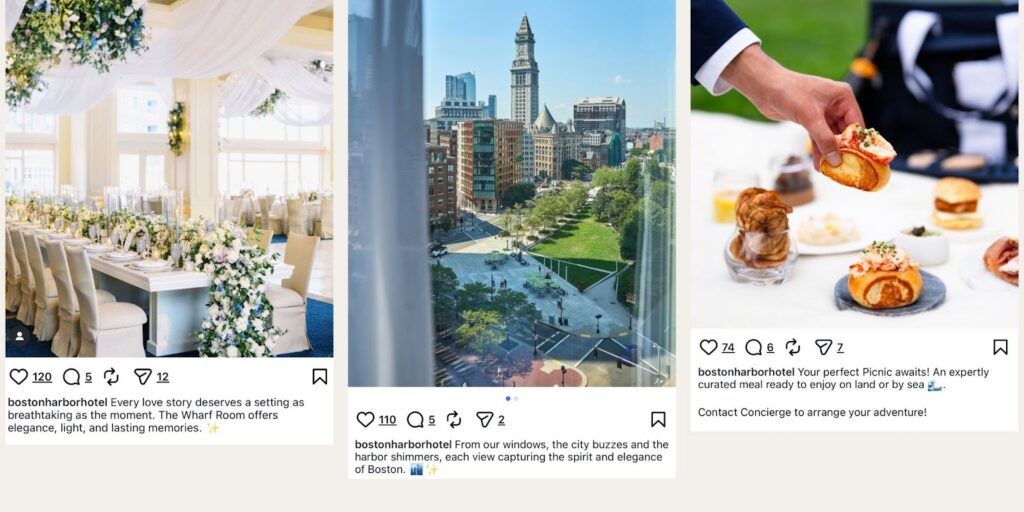
At GCommerce, we’ve seen hospitality brands like Boston Harbor Hotel achieve stronger performance when captions are tailored to the platform and audience. For example, short, experience-driven captions paired with stunning visuals tend to perform well on Instagram, while longer, story-focused copy that highlights seasonal offerings or guest experiences can drive deeper engagement on Facebook. Well-written, platform-specific copy helps set expectations, spark interest, and create meaningful interaction.
Pro tip: Customize your copy by channel. What works on Instagram may not perform the same on Facebook or LinkedIn, so adjust caption length, tone, and calls to action based on how travelers engage on each platform.
8. Visuals matter
High-quality visuals remain among the most engaging content formats. Use strong images and videos that represent your brand well and reflect the experience you offer. For example, the visuals shared by Asher Adams Hotel showcase how cohesive styling, consistent tones, and thoughtful composition can elevate a brand’s presence across social platforms.
Keep a unified visual style with consistent colors, fonts, and filters, prioritize video formats such as Reels, TikToks, and Stories, and refresh creative assets regularly to prevent fatigue. Strong visuals help establish recognition and grab attention quickly.
Pro tip: Create a reusable visual template with your brand colors and fonts so new content stays consistent even when creative is produced quickly.
9. Get inspired by the best
Studying successful hospitality brands can help shape your own strategy. Across GCommerce client work, the most effective organic social content highlights the experience behind the stay through immersive visuals, consistent branding, and story-driven captions. Whether showcasing a destination, an on-property experience, or a seasonal moment, strong content inspires travelers while remaining authentic to the brand. Look to what resonates, adapt the approach to your audience, and make it your own. Inspiration is valuable, but authenticity is what builds loyalty.
Pro tip: Follow three to five brands inside or outside your industry and save posts that stand out. Use them as inspiration for format or storytelling, then adapt the idea to fit your own brand voice.
10. Build AI visibility through structured social posts
As search and discovery continue to evolve, organic social content is beginning to play a larger role in how brands surface within AI-driven experiences. As part of GCommerce’s AEO beta testing, we are exploring how structured, answer-oriented social posts can support visibility beyond traditional feeds. This approach focuses on creating:
two to three intentional posts per month that clearly answer common traveler questions, highlight key brand differentiators, and guide users to high-value content on your site.
Carousel posts with overlay text help break information into scannable, digestible pieces,
Linking to schema-optimized pages, blogs, news, reviews, or brand features reinforces authority and relevance across platforms.
When executed thoughtfully, structured social content can support both audience engagement and emerging AI discovery pathways.
Pro tip:Identify three common questions travelers ask about your property or destination, then turn each into a carousel post with clear overlay text and a link to a relevant, schema-supported page on your website.
Organic social media remains one of the most effective ways to build genuine relationships and long-term brand loyalty. So what can brands do today? Start by committing to consistent posting over the next 30 days, engaging with your audience by responding to comments and messages within 24 hours, testing short-form video or interactive content on a key platform, and refreshing creative assets to avoid creative fatigue.
As platforms continue to evolve, an adaptable and authentic approach will help brands stay relevant and connected. If you’d like to learn more about evolving your organic social strategy, reach out to the experts at GCommerce today.
Commonly asked questions about organic social media best practices
How often should hotels post on organic social media?
Hotels should aim to post consistently, ideally three to five times per week, to stay top of mind and build trust with their audience. A regular posting schedule helps reinforce brand recognition and signals reliability to both users and platform algorithms.
What type of content performs best for hotel social media?
High-quality, engaging content that educates, inspires, or entertains tends to perform best. This includes strong visuals, short-form videos, user-generated content, and captions tailored to each platform. Prioritizing quality over quantity leads to stronger long-term engagement and brand loyalty.
How can hotels improve engagement on social media?
Hotels can boost engagement by actively responding to comments and messages, using interactive features like polls and quizzes, and sharing authentic guest experiences. Building a community through genuine interaction, not just broadcasting content, is key to long-term success.
The hospitality data platform: What it means and why hotels should care
The hospitality data platform: What it means and why hotels should care
Every hotel marketer knows the challenge. There’s more data than ever, but it lives everywhere and connects nowhere. Media reports sit in one dashboard. Booking data is stored in another. Benchmarks arrive by email. Guest behavior is buried in CRMs. The result is a fragmented view that makes decision-making harder than it should be.
The hospitality data platform changes that. It is more than a reporting tool. It is an intelligent infrastructure built to unify the information that drives performance—media, bookings, operations, and market insights—into a single, connected ecosystem.
This is the difference between visibility and intelligence.
When data is fragmented, opportunities slip through the cracks. Without unified insights, a property might overspend on paid search while missing retargeting opportunities. Multi-property groups can struggle to see where one hotel is outperforming another. And without accurate channel attribution, bookings may be credited to OTAs that could have been direct.
A hospitality data platform eliminates that disconnect. It gives hoteliers a complete, actionable view of performance across every level of their business.
What a hospitality data platform enables
See the whole picture Access every layer of performance, from individual campaigns to portfolio-wide insights, in one centralized view.
Benchmark with confidence Compare performance against market peers, property types, and channels using real-time hospitality benchmarks.
Respond faster Spot shifts in demand early, adjust campaigns automatically, and align spend with the channels that drive profitable bookings.
Forecast smarter Use predictive intelligence to anticipate demand instead of reacting to it after the fact.
More than connection—activation
A hospitality data platform does not replace your agency, booking engine, or CRM. It amplifies them. It brings each system into a connected framework where data powers every decision.
When media, revenue, and guest data work together, the conversation shifts from “what happened last month” to “what will happen next—and how can we act on it?”
This is what turns information into intelligence and strategy into growth.
Why it matters now
Competition from OTAs is rising. Media costs continue to climb. Guest expectations are evolving. Hoteliers who rely on disconnected systems will fall behind, while those who invest in unified data will lead.
A true hospitality data platform allows hotels and resorts to move from fragmented reporting to proactive performance management. It empowers teams to make faster, smarter decisions—and to increase direct bookings with clarity and control.
The future of hospitality intelligence
The hospitality industry doesn’t need more tools. It needs better connections between them. That’s what the hospitality data platform delivers: one source of truth, purpose-built for hotels, management companies, and partners who want to understand not just what happened, but what to do next.
It is the foundation for how hospitality marketing, media, and data will work together in the years ahead. And it is how GCommerce is helping hotels turn data into growth.
Ready to unify your marketing data and uncover the insights driving your next direct booking? Connect with GCommerce to learn how our Hospitality Data Platform brings intelligence, transparency, and performance together for hotels and resorts. Get in touch today.
The role of color psychology in hospitality marketing
How color shapes guest perception and decision-making
First impressions in hospitality are formed within seconds, often before guests are consciously aware. From a digital advertisement to the hotel lobby, people start evaluating their surroundings almost immediately. Color plays a major role in this process, serving as a powerful tool for shaping guest expectations and experiences.
What is color psychology, and why it matters
Color psychology studies how different colors influence our emotions, perceptions, and behaviors. In marketing, colors can guide attention, communicate brand values, and influence decisions. For hospitality brands, color choices go beyond decoration—every shade used in rooms, websites, or marketing materials shapes the guest experience. When chosen thoughtfully, colors can help guests feel comfortable, inspired, or excited, depending on the brand’s goals.
Emotional engagement is at the heart of hospitality marketing. Research shows that visual cues, especially color, strongly affect purchasing decisions. For example, marketing scholar Satyendra Singh found that color can be used to stimulate appetite, lift mood, calm guests, and even make wait times feel shorter. In practical terms, the colors guests encounter in a restaurant, spa, or hotel room shape how they feel and influence their next actions.
Emotional associations of common colors
Certain colors consistently trigger emotional responses that hospitality brands can strategically leverage.
Red
Red conveys energy and urgency, making it popular in dining spaces and promotional messaging.
Blue
Blue communicates calm, trust, and reliability—qualities often seen in hotels, resorts, and wellness brands.
Yellow
Yellow evokes warmth and optimism, drawing attention when used thoughtfully.
Green
Green aligns with nature, wellness, and balance, which is ideal for eco-focused properties or spa areas.
Orange
Orange signals friendliness and enthusiasm, making it effective for calls to action.
Purple
Purple suggests luxury, creativity, and exclusivity, making it a fitting choice for premium experiences.
Neutral tones
Neutral tones like white, gray, and black convey simplicity, sophistication, and timelessness.
However, the emotional impact of colors can vary based on culture, context, and audience. It’s important to select colors that will connect with your specific guests.
Using color psychology across digital marketing channels
Color isn’t just for physical spaces; it plays a vital role in digital marketing, too. Social media ads can stand out with high-saturation warm colors, while display banners benefit from high-contrast combinations that draw attention to key messages. Websites and email campaigns often use a single accent color for calls to action, guiding guests to book or engage without disrupting brand cohesion.
Many think color psychology requires a full rebrand. In reality, it works best by enhancing existing brand colors.
Hospitality marketers can boost results by introducing accent colors, using lighter or darker shades for contrast, and applying complementary colors in digital campaigns without altering physical spaces. For example, a brand with cool blues and grays can preserve its calm, trustworthy feel while adding a warm accent CTA color to increase engagement
Color psychology applications in hospitality environments
Hotel lobbies and guest rooms
The lobby is often a guest’s first physical point of contact with a brand. Warm accent colors can energize the space and make it memorable, while cooler tones encourage relaxation and a sense of luxury. Guest rooms typically feature soft blues, greens, or neutral shades, creating a calm environment that aligns with expectations for comfort and rest.
Restaurants and dining spaces
Dining environments benefit from warm colors that stimulate appetite and encourage conversation. A well-chosen palette can even influence how long guests stay and how much they enjoy their meals, subtly enhancing both satisfaction and revenue.
Spas and wellness areas
Spas and wellness centers usually favor muted blues, greens, and neutral tones. These colors create a sense of cleanliness and serenity, helping guests relax and recharge. Even small touches, like towel colors, artwork, or amenity packaging, can reinforce the desired experience.
Best practices for applying color psychology to your hotel marketing
To get the most from color psychology in hospitality:
Keep colors consistent across physical and digital touchpoints to strengthen recognition.
Consider cultural nuances, as the meanings of colors can vary between audiences.
Make designs accessible, ensuring sufficient contrast and clarity for all guests.
Balance neutral and accent colors to avoid overstimulation.
Test and refine color choices over time to see what resonates most with your audience.
Color is one of the quickest and most effective ways to influence how guests perceive and respond to your brand. When used thoughtfully, it can enhance the guest experience, reinforce brand identity, and boost marketing effectiveness, without changing the brand’s fundamental look. By understanding how color shapes emotions and decisions, hospitality marketers can create spaces and campaigns that feel natural and engaging, creating lasting connections with guests.
If you're ready to learn about how your property's branding can be conveyed through digital marketing, reach out to experts at GCommerce today!
Commonly asked questions about color physology hotels
What colors work best for hospitality brands?
The best colors depend on the brand and guest experience you want to create. Blue and green are often used for calm and relaxation, purple for luxury, yellow for warmth and optimism, and neutral tones for sophistication and simplicity.
Where should hospitality brands use color psychology?
Color psychology should be applied across both physical and digital spaces, including hotel lobbies, guest rooms, restaurants, websites, email marketing, social media ads, and booking engines to create a consistent brand experience.
Do hospitality brands need a full rebrand to use color psychology?
No, most hospitality brands can apply color psychology by introducing accent colors, adjusting contrast, or using complementary colors in digital marketing without changing their entire brand identity.